Novel Antibiotics
"Overall, the antibacterial agents, especially the innovative ones, in the clinical pipeline combined with those approved in the last seven years are still insufficient to tackle the ever-growing threat of the emergence and spread of drug-resistant infections "
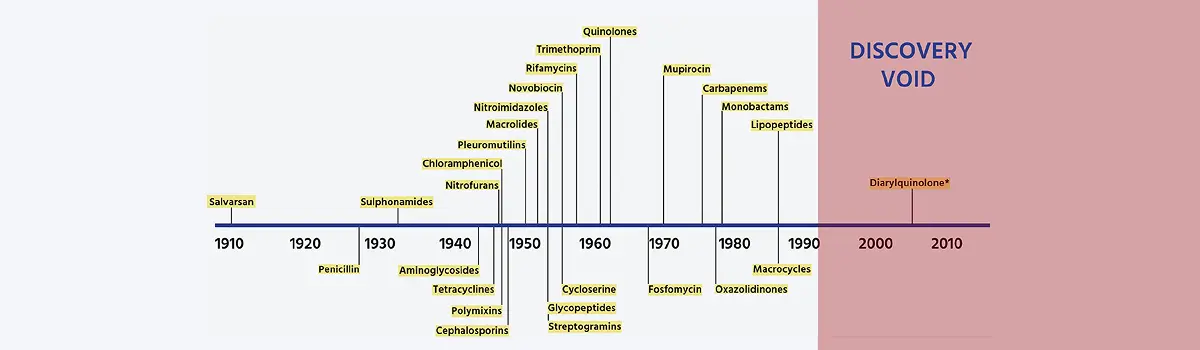
Photograph/Illustration: Fig. 2: The antibiotic discovery void, https://doi.org/10.1038/s44259-025-00123-1
This section’s focus is on current strategies, tools and technologies used in discovering and developing novel antibiotics. Researchers are attacking the problem from multiple angles because no single approach is enough to overcome modern antimicrobial resistance. This section surveys and contains new findings attempting to replenish the antibiotic pipeline and armamentarium, including re-purposing of drugs intended for other diseases. In this category we will also devote attention to more fundamental findings, breakthroughs and translational research believed to have a potential impact on AMR.
Other areas & keywords in this category also covers:
- Basic Research: Discovery and mechanisms of action.
- Research & Development (R&D): Pre-clinical and clinical studies of novel antibiotic agents.
- Outsourcing: as a startup you will most likely be on the outlook for service providers that can assist and bring their capabilities and capacities at your disposal so CDMOs and regulatory information will appear here also
If you are engaged in developing novel therapeutics you might wish to take a peek at our eSolutions, mHealth & HealthIT for additional inspiration. Said category covers the growing field of AI supported innovation.
Are you searching for funding by means of soft money you may be interested in our Service section’s Funds & Grants category. News and information on equity investment opportunities are placed in Matchmaking and Partnering.
News
View allAI Can Already Build a Bioweapon. Is It Too Late to Stop?
Abstract
Anthropic calls this the dual-use" problem, and it is the reason the company argues that filtering alone cannot keep an AI model safe in a field like biology, where the knowledge required to cure a disease and the knowledge required to engineer one are often the same knowledge, held by the same researcher, in the same paper. Geoffrey Hinton, the Nobel laureate, told the BBC that "a 10% chance seems not an unreasonable estimate to me," and Samuel Marks, who leads scalable oversight work at Anthropic, observed that "the more senior the employee, the more concerned they are." Three days later, Dario Amodei, Anthropic's chief executive, gave the argument its most formal statement yet, in an essay titled "We Must Pace the Frontier": "We must slow the pace at which we improve the capabilities of AI models." Sam Altman, OpenAI's chief executive, said his company would match Anthropic's commitment – going as far to delay their 2026 IPO – and Elon Musk posted simply that "Dario is right." Anthropic's public policy chief, Sarah Heck, took the argument to Washington, calling for federal legislation that would require frontier model testing and give regulators the power to block unsafe models. Speaking in Ireland on September 13, President Trump said he had no concerns about AI causing human extinction and dismissed the warnings as coming from "negative forces," adding: "We are leading China right now by a pretty good period, I would say a year." David Sacks, who now co-chairs the President's Council of Advisors on Science and Technology, told Altman and Amodei on X that he supported their right to slow down individually but made clear no federal mandate was coming: "I don't see what you see in the lab." House Speaker Mike Johnson opposed any moratorium on the grounds that "China will overtake" the United States. Insilico's founder, Alex Zhavoronkov, frames the competitive picture directly, saying his company now "competes with Chinese pharmaceutical companies on timelines." Geoffrey von Maltzahn, chief executive of Lila Sciences, put the stakes in national terms at Fortune's Brainstorm Tech conference: "Falling below the scientific intelligence of one's adversary at a corporate level, at a sovereign level, is almost like an unimaginable competitive disadvantage." Kimberly Powell, Nvidia's vice president of healthcare, made the same point from the funding side: "If we defund now, while the rest of the world leans in, we will be left behind." Five cases that turn the warning into something specific Anthropic's Threat Intelligence Report disclosed five documented attempts to use Claude models to support biological weapons development, a rare instance of an AI company publishing this kind of misuse data at all."White paper: Understanding drug selectivity and pocket druggability
Abstract
Understanding compound selectivity is vital when designing novel pharmaceuticals. The extent of on- and off-target effects, or potential polypharmacology, informs modifications to develop safe and effective drugs. In this white paper we present a data-driven drug design method which visualizes binding site comparisons across a protein family, to deeply understand selectivity and pocket druggability. These Ensemble Hotspot Maps" are derived from peer-reviewed, experimentally-generated data in the Cambridge Structural Database, and automated to rapidly and visually guide target validation and drug design."Finding a place for new approach methodologies (NAMs) in biomedical research
Abstract
Moreover, we propose the use of clinical outcome pathways (COPs), originally introduced as a framework linking mechanistic biology to clinical outcomes, as a basis for guiding the use of NAMs in biomedical research and for supporting a more systematic implementation of non-animal approaches. To broaden the adoption of NAMs, it is essential to move beyond the question of regulatory obligation, 'do I have to use animal models?', and instead focus on the scientific possibilities: 'how can NAMs enhance and transform my research?'. More specifically, COPs could help to: define which biological events are most critical to capture in relation to disease onset, progression or therapeutic response, assess whether currently available NAMs represent these events with sufficient biological relevance, identify where multiple NAMs need to be combined to capture interacting processes across cell types, tissues, organs or disease stages, highlight areas where no suitable NAM currently exists, thereby guiding the prioritization of future model development, support the design of testing strategies in which NAMs are selected based on their ability to address clearly defined mechanistic questions rather than on convenience alone, facilitate interpretation of NAM-derived findings by anchoring individual readouts within a broader disease pathway, thereby clarifying what a given result may mean in relation to downstream clinical outcomes, and improve the translational value of NAM-based research by more explicitly linking non-animal experimental outputs to clinically meaningful endpoints. Authors and Affiliations Finnish Hub for Development and Validation of Integrated Approaches, Faculty of Medicine and Health Technology, Tampere University, Tampere, Finland Tampere Institute for Advanced Study, Tampere University, Tampere, Finland Institute of Medical Biochemistry, Medical University Innsbruck, Innsbruck, Austria Department of Information Engineering, University of Pisa, Centro 3R, Pisa, Italy 3Rs Centre Utrecht, Utrecht University, Utrecht, the Netherlands i3S – Instituto de Investigação e Inovação em Saúde, Universidade do Porto, Porto, Portugal Nuno H. Franco & I. Anna S. Olsson Austrian Institute of Technology, Vienna, Austria Faculty of Medicine and Dentistry, Danube Private University, Krems, Austria Department of Neuromedicine and Movement Science, Norwegian University of Science and Technology, Trondheim, Norway Contributions Beyond the first author, the author list is in alphabetical order.As antibiotic resistance grows, researchers turn to copper to fight infections
Abstract
When bacteria invade the urinary tract, the body has its own arsenal for fighting back. Among those weapons is an unlikely tool: copper. Researchers at the Texas A&M College of Veterinary Medicine and Biomedical Sciences (VMBS) are investigating how the body uses the essential trace mineral to fight urinary tract infections (UTIs), how bacteria manage to survive that attack and whether those discoveries could eventually lead to new ways of treating infections that are increasingly difficult to control with antibiotics.Lund startup Halmos Labs joins Y Combinator to build automated biotech R&D
Abstract
Halmos Labs, a new biotech startup based in Lund, has joined Y Combinator's fall 2026 batch, and thereby also secured $500K in first funding. Halmos Labs builds automated biotech R&D on the principles of validity and interpretabillity. While the company itself is named Halmos Labs, its first product will be called Halmos Bio, founder Mattias Akke tells Swedish Tech News which was first with reporting the news. The founders, Mattias Akke and Linus von Ekensteen Löfgren, have a background in Nanotechnology and Engineering Physics, and previous experience from MIT, AstraZenica, and Danske Bank.